Can You Lose Weight with Pills? 

Studies show that many doctors either tend to overestimate the amount of weight that can be lost with obesity drugs or are simply clueless. 

Current options for weight-loss medications include the ridiculously named Qsymia, a combination of phentermine (the phen in fen-phen) and topiramate, a drug that can cause seizures if you stop it abruptly. Qsymia was “explicitly rejected multiple times for safety reasons in Europe “because of concerns about the medicine’s long-term effects on the heart and blood vessels” but, at the time of making my video Are Weight Loss Pills Effective?, remains available for sale in the United States. Belviq is in a similar boat—allowed in the United States but not in Europe due to “concerns about possible cancers, psychiatric disorders, and heart valve problems…”  

Belviq is sold in the United States for about $200 a month. If you think that’s a lot, there’s Saxenda, which requires daily injections and is listed at the low, low price of only $1,281.96 for a 30-day supply. It carries a black box warning, the FDA’s strictest caution about potentially life-threatening hazards, for thyroid cancer risk. Paid consultants and employees of the company that makes it argue the greater number of breast tumors found among drug recipients may be due to “enhanced ascertainment,” meaning easier breast cancer detection just due to the drug’s effectiveness. 

Contrave is another option if you ignore its black box warning about a potential increase in suicidal thoughts. Then there’s Alli, the drug that causes fat malabsorption, thereby resulting in side effects “including fecal urgency, oily stool, flatus with discharge, and fecal incontinence”—Alli can be your ally in anal leakage. The drug evidently “forces the patient to use diapers and to know the location of all the bathrooms in the neighborhood in an attempt to limit the consequences of urgent leakage of oily fecal matter.” A Freedom of Information Act exposé found that although company-sponsored studies claimed that “all adverse events were recorded,” one trial apparently conveniently failed to mention 1,318 of them. 

What’s a little bowel leakage, though, compared to the ravages of obesity? As with anything in life, it’s all about risks versus benefits. However, in an analysis of more than a hundred clinical trials of anti-obesity medications that lasted up to 47 weeks, drug-induced weight loss never exceeded more than nine pounds. That’s a lot of money and a lot of risk for just a few pounds. Since you aren’t treating the underlying cause—a fattening diet—when people stop taking these drugs, the weight tends to come right back, so you’d have to take them every day for the rest of your life. But people do stop taking them. Using pharmacy data from a million people, most Alli users stopped after the very first purchase and most Meridia users didn’t even make it three months. Taking weight-loss meds is so disagreeable that 98 percent of users stopped taking them within the first year. 

Studies show that many doctors tend to overestimate the amount of weight that can be lost with these drugs or are simply clueless. One reason may be that some clinical practice guidelines go out of their way to advocate prescribing medications for obesity. Are they seriously recommending drugging a third of Americans—more than 100 million people? You may not be surprised to learn that the principal author of the guidelines has a “significant financial interest or leadership position” in six separate pharmaceutical companies that all (coincidently) work on obesity drugs. In contrast, independent expert panels, like the Canadian Task Force on Preventive Health Care, explicitly recommend against weight-loss drugs, given their poor track record of safety and efficacy. 

In case you missed my related video, check out Are Weight Loss Pills Safe?.

As with all lifestyle diseases, it’s better to treat the underlying cause, which, in the case of obesity, is a fattening diet. For an example of what’s possible with a healthy diet intervention, see Flashback Friday: The Weight Loss Program That Got Better with Time. 

Check out the related videos below for more about weight loss. 

from NutritionFacts.org https://ift.tt/hLeEQ21
via IFTTT
Leftover Turkey Noodle Soup

My favorite way to use leftover turkey is to make a delicious pot of turkey noodle soup. It’s also an excellent way to clean out your refrigerator! Turkey Noodle Soup Don’t throw out the turkey bones after Thanksgiving! Making homemade turkey stock with bones is the secret to the best-tasting soup. I promise it’s easy!

from Skinnytaste https://ift.tt/9mr8uKX
via IFTTT

Turkey Stock for Gravy

There’s no denying that the secret to a memorable turkey gravy lies in its base: a rich, flavorful stock. Once you’ve made your own turkey stock, there’s no going back to the store-bought stuff. Turkey Stock for Gravy Thanksgiving wouldn’t be complete without the quintessential turkey gravy to drizzle over tender slices of turkey, creamy

from Skinnytaste https://ift.tt/V2bRHP9
via IFTTT

Cornbread Muffins

Adding fresh corn to cornbread muffins makes them moist and delicious, you’ll never know they’re light! Cornbread Muffins For years, I tried to make a healthier, low-fat cornbread, but I never liked the results and always gave up. That was until I tested a cornbread recipe for Skinnytaste Simple using grated zucchini that came out

from Skinnytaste https://ift.tt/43XBdSY
via IFTTT

Make-Ahead Low-Carb Turkey Gravy (Flourless)

Rich turkey stock and pureed roasted vegetables create a creamy low-carb turkey gravy without flour. Low-Carb Gravy Roasting turkey wings, neck, or parts along with cauliflower, onion, and garlic gives you a rich turkey stock, which creates this luscious, low-carb turkey gravy with no flour. Then the vegetables get pureed along with the stock to

from Skinnytaste https://ift.tt/zDo65lw
via IFTTT

Is It Safe to Take Weight-Loss Pills? 

Why don’t more people take the weight-loss medications currently on the market? 

Despite the myriad menus of FDA-approved medications for weight loss, they’ve only been prescribed for about 1 in 50 patients with obesity. We tend to worship medical magic bullets in the United States, so what gives? As I discuss in my video Friday Favorites: Are Weight-Loss Supplements Safe and Effective?, one of the reasons anti-obesity drugs are so “highly stigmatized is that, historically, they’ve been anything but magical and the bullets have been blanks—or worse. 

To date, most weight-loss drugs that were initially approved as safe have since been pulled from the market for unforeseen side effects that turned them into a “threat to public health.” As you may remember from my video Brown Fat: Losing Weight Through Thermogenesis, it all started with DNP, a pesticide with a promise to safely melt away fat that melted away people’s eyesight instead. (That actually helped lead to the passage of the landmark Food, Drug, and Cosmetic Act in 1938.) Thanks to the internet, DNP has made a comeback with “predictably lethal results.” 

Then came the amphetamines. Currently, more than half a million Americans may be addicted to amphetamines like crystal meth, but the “original amphetamine epidemic was generated by the pharmaceutical industry and medical profession.” By the 1960s, drug companies were churning out about 80,000 kilos of amphetamines a year, which is nearly enough for a weekly dose for every man, woman, and child in the United States. Billions of doses a year were prescribed for weight loss, and weight-loss clinics were raking in huge profits. A dispensing diet doctor could buy 100,000 amphetamine tablets for less than $100, then turn around and sell them to patients for $12,000.  

At a 1970 Senate Hearing, Senator Thomas Dodd (father of “Dodd-Frank” Senator Chris Dodd) suggested that America’s speed freak problem “was no by means an ‘accidental development’: ‘Multihundred million dollar advertising budgets, frequently the most costly ingredient in the price of a pill, have, pill by pill, led, coaxed and seduced post-World War II generations into the ‘freaked-out’ drug culture…’” I’ll leave drawing the Big Pharma parallels to the current opioid crisis as an exercise for the viewer.  

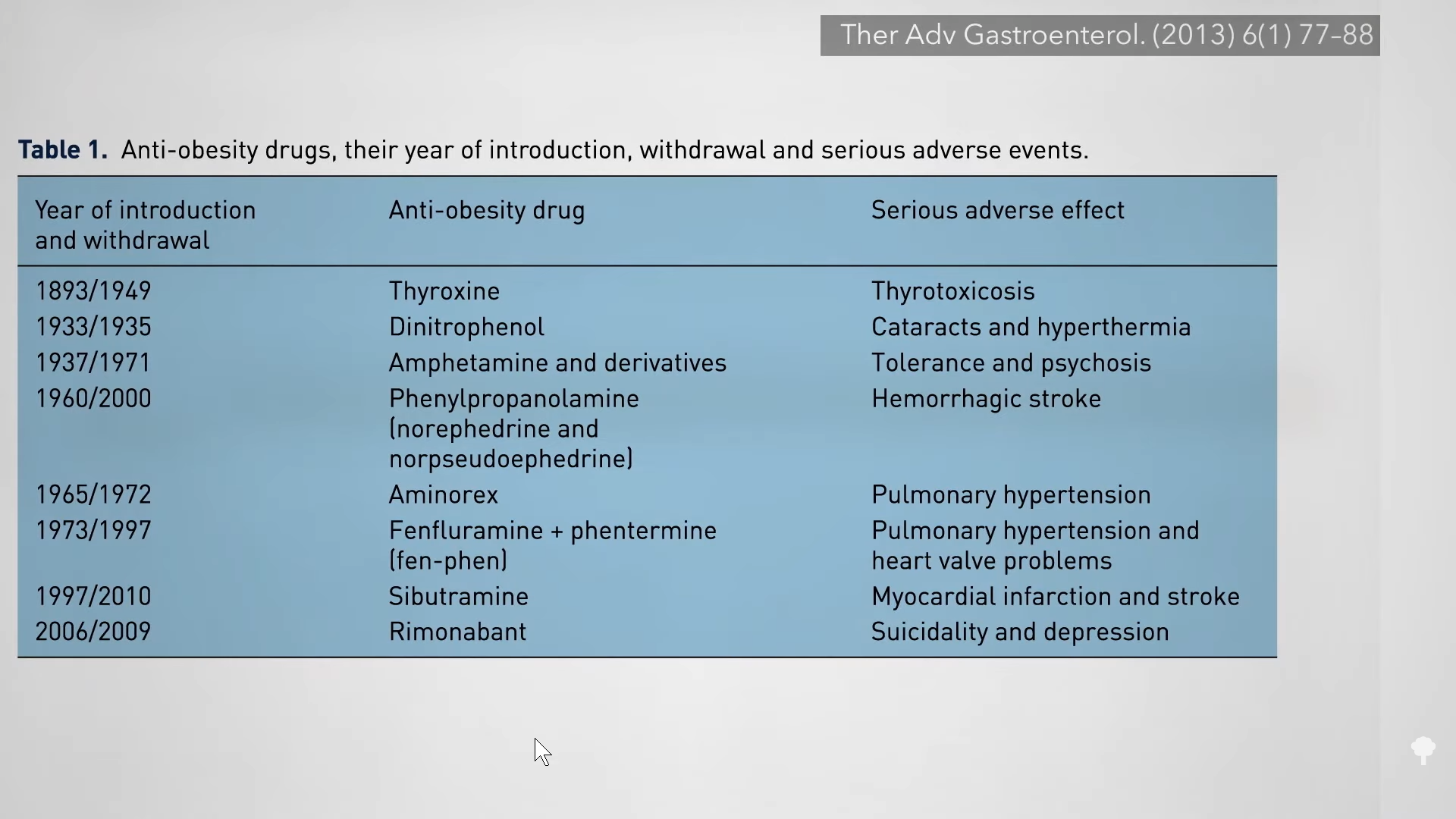
Aminorex was a widely-prescribed appetite suppressant before it was pulled for causing lung damage. Eighteen million Americans were on fen-phen before it was pulled from the market for causing severe damage to heart valves. Meridia was pulled for heart attacks and strokes, Acomplia was pulled for psychiatric side effects, including suicide, and the list goes on, as you can see below and at 2:51 in my video. 

The fen-phen debacle resulted in “some of the largest litigation pay-outs ever seen in the pharmaceutical industry, with individual amounts of up to US$200,000 and a total value of ~US$14 billion,” but that’s all baked into the formula. If you read the journal PharmacoEconomics (and who doesn’t!), you may be aware that a new weight-loss drug may injure and kill so many that “expected litigation cost” could exceed $80 million, but Big Pharma consultants estimate that if it’s successful, the drug could bring in more than $100 million, so do the math. 

What does work for weight loss? I dive deep into that and more in How Not to Diet.  For more of my videos on weight loss, check out the related videos below. 

from NutritionFacts.org https://ift.tt/Wa5wBS6
via IFTTT

Thanksgiving Menu with Make Ahead Options

Hosting a holiday dinner can be stressful – but it doesn’t to be! From appetizers and sides to turkey and dessert, this Thanksgiving Menu with Make Ahead Options takes the stress out of what to make and when to make it. The Perfect Thanksgiving Menu It’s probably no surprise that I love Thanksgiving. It’s one

from Skinnytaste https://ift.tt/aLE8PYW
via IFTTT

Turkey Roulade (Stuffed Turkey Breast)

This Turkey Roulade with Cranberry Stuffing and gravy is the perfect Thanksgiving or Holiday meal for a smaller gathering. Turkey Roulade This Stuffed Turkey Breast with Cranberry Stuffing also known as a Turkey Roulade is great when you don’t need to make a whole bird, such as for a smaller family Thanksgiving or Friendsgiving. I

from Skinnytaste https://ift.tt/iztbWlN
via IFTTT

30 Amazing Gifts for People Who Love to Cook

I might be a little biased, but I think it’s a lot of fun to shop for the best cooking gifts (I’m always in the kitchen, after all!). There are so many great kitchen tools and accessories out there that make amazing holiday gifts, so if you’re shopping for a home cook, I’ve rounded up

from Skinnytaste https://ift.tt/GeZB4o8
via IFTTT

Design a site like this with WordPress.com
Get started