The First Studies on Vegetarian vs. Meat-Eating Athletes

Meat-eating athletes are put to the test against vegetarian athletes and even sedentary plant-eaters in feats of endurance.

“In 1896, the aptly named James Parsley led the Vegetarian Cycling Club to easy victory over two regular clubs. A week later, he won the most prestigious hill-climbing race in England….Other members of the club also turned in remarkable performances. Their competitors were having to eat crow with their beef.” Then, a Belgian researcher put it to the test in 1904 and found that those eating more plant-based reportedly lifted a weight 80 percent more times. (I couldn’t find the primary source in English, though.) I did find a famous series of experiments at Yale, published more than a century ago, on “the influence of flesh eating on endurance,” which I discuss in my video The First Studies on Vegetarian Athletes.

The Yale study compared 49 people: meat-eating athletes (mostly Yale students), vegetarian athletes, and sedentary vegetarians. “The experiment furnished a severe test of the claims of the flesh-abstainers.” And, “much to my surprise,” wrote the researcher, the results seemed to vindicate the vegetarians, suggesting that those eschewing meat “have far greater endurance than those who are accustomed to the ordinary American diet.”

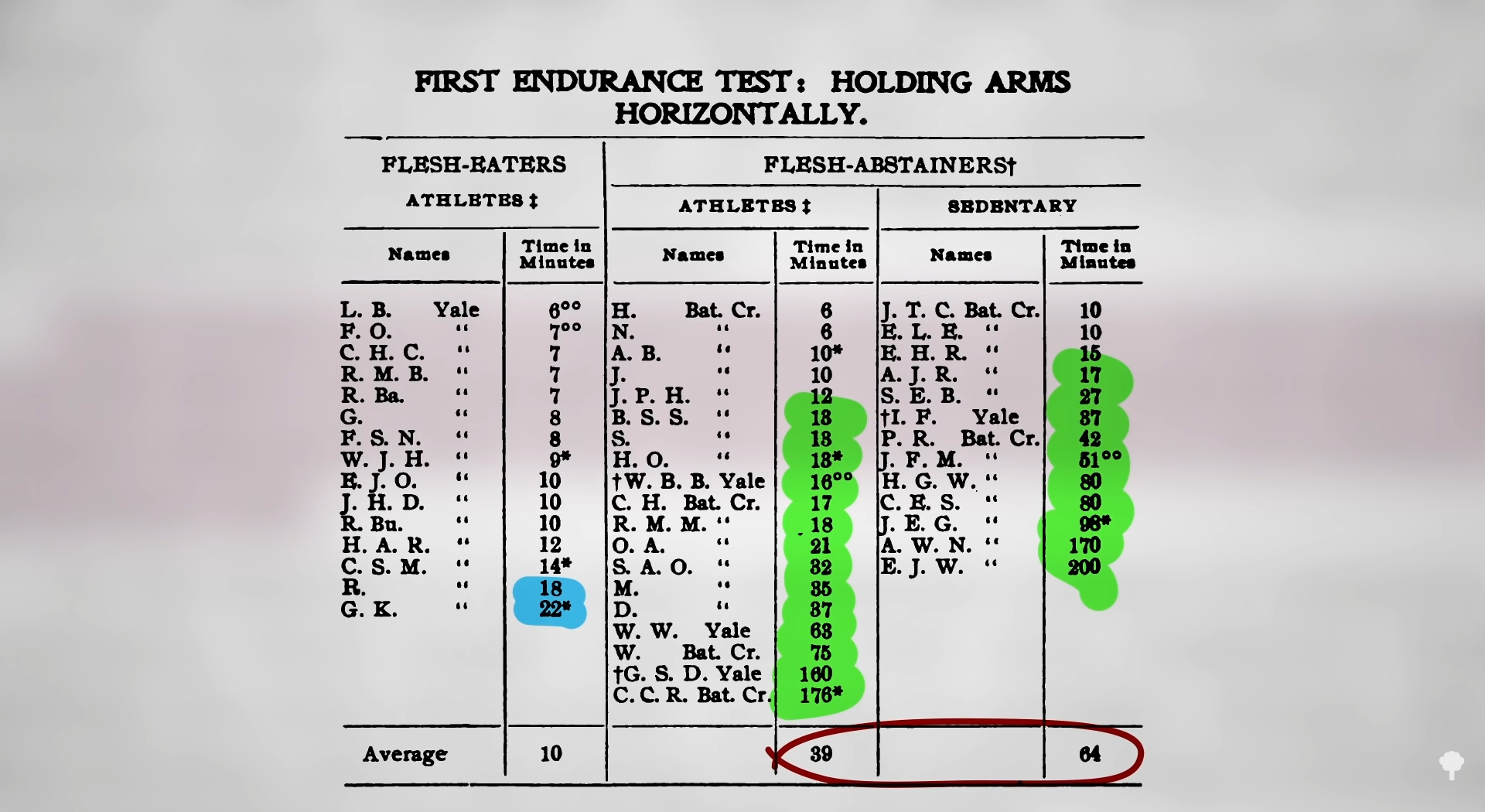
As you can see at 1:12 in my video, the first endurance test measured how many continuous minutes the participants could hold out their arms horizontally: “flesh-eaters” versus “flesh-abstainers.” The meat-eating Yale athletes were able to keep their arms extended for about ten minutes on average. (It’s harder than it sounds. Give it a try!) The vegetarians did about five times better. The meat-eater maximum time was only half the vegetarian average. Only two meat-eaters hit 15 minutes, while more than two-thirds of the meat-avoiders did. None of the meat-eating athletes hit half an hour, while nearly half of the plant-eaters did. This included nine who exceeded an hour, four who exceeded two hours, and one participant who kept going for more than three hours.
How many deep knee bends can you do? One meat-eating athlete did more than 1,000, with the group as a whole averaging 383, but the plant-eating athletes creamed them, averaging 927. Even the sedentary vegetarians performed better than the meat-eating athletes; they averaged 535 deep knee bends. That’s wild! “Even the sedentary [meat] abstainers surpassed the exercising flesh-eaters” in performance. In most cases, the sedentary plant-eaters were physicians who sat on their butts all day. I want a doctor who can do a thousand deep knee bends! As you can see at 2:15 in my video.
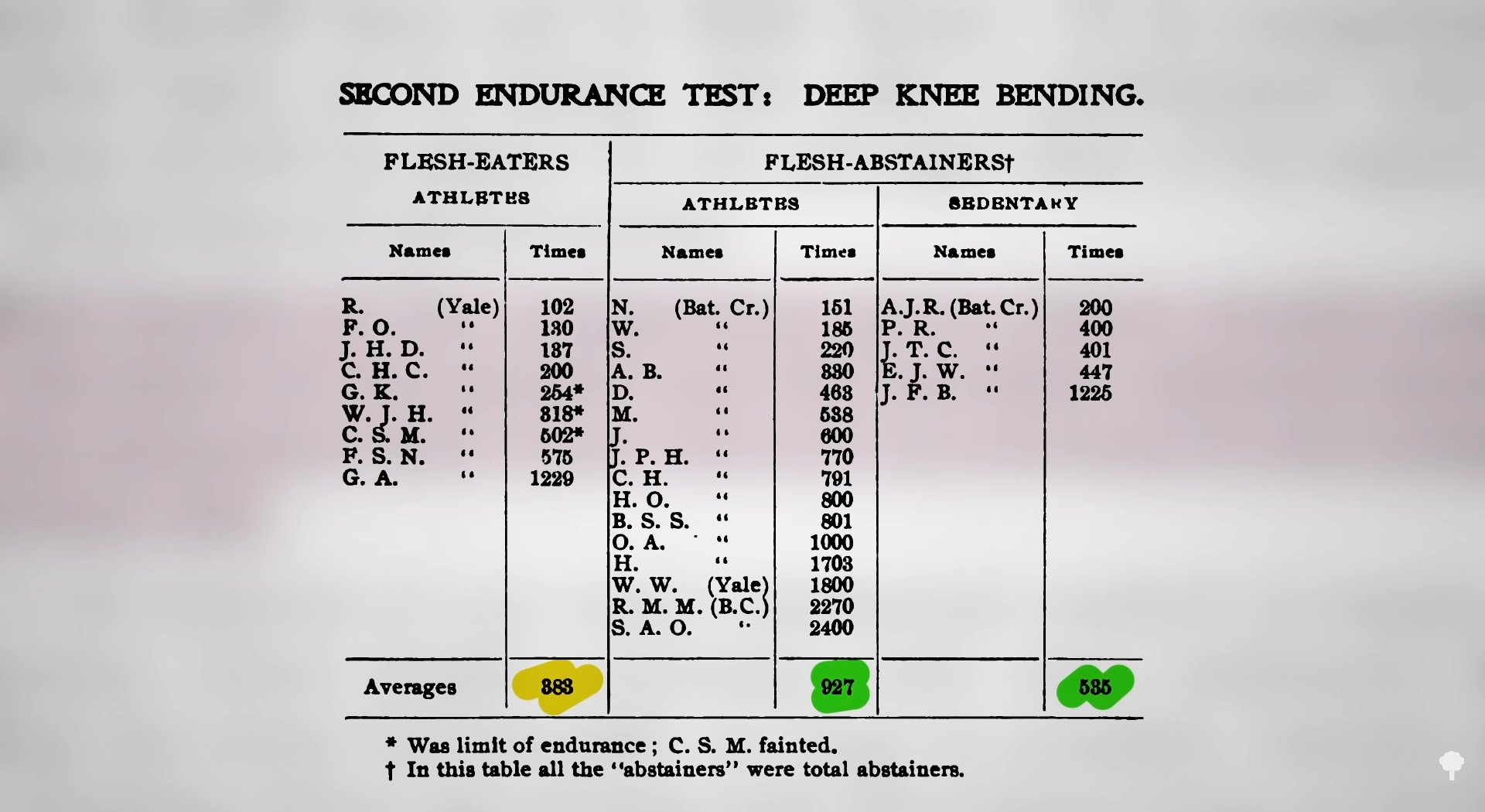
Then, in terms of recovery, all of those deep knee bends left everyone sore, but much more so among those eating meat. Among the vegetarians, of the two who did about 2,000 knee bends each, one went straight off to the track to run and the other went on to their nursing duties. Among the meat-eaters, one athlete “reached his absolute limit at 254 times, and was unable to rise from a stooping posture the 255th time. He had to be carried downstairs after the test, and was incapacitated for several days.” Another meat-eating athlete was impaired for weeks after fainting.

“It may be inferred without reasonable doubt,” concluded the once skeptical Yale researcher, “that the flesh-eating group of athletes was very far inferior in endurance to the abstainers,” the vegetarians, “even the sedentary group.” What could account for this remarkable difference? Some claimed that flesh foods contained some kind of “fatigue poisons,” but one German researcher who detailed his own experiments with athletes offered a more prosaic answer. In his book, Physiologische Studien über Vegetarismus—looks like Physiological Studies of Uber-Driving Vegetarians, doesn’t it? (I told you I only know English)—he conjectured that the apparent vegetarian superiority was due to their tremendous determination “to prove the correctness of their principles and to spread their propaganda.” If we believe him, vegetarians apparently just make a greater effort in any contest than do their meat-eating rivals. The Yale researchers were worried about this, so “special pains were taken to stimulate the flesh-eaters to the utmost,” appealing to their college pride. Don’t let those lousy vegetarians beat the “Yale spirit”!

The Yale experiments made it into The New York Times. “Yale’s Flesh-Eating Athletes”—sounds like the title of a zombie movie so far, doesn’t it?—“Beaten in Severe Endurance Tests.” “Prof. Irving Fisher of Yale believes that he has shown definitely the inferiority in strength and endurance tests of meat eaters to those who do not eat meat…Some of Yale’s most successful athletes took part in the strength tests for meat eaters, and Prof. Fisher declares they were obliged to admit their inferiority in strength.” How has the truth of this result been so long obscured? One reason, Professor Fisher suggested, is that vegetarians are their own worst enemy. In their “vegetarian fanaticism,” they jump from the premise that meat-eating is wrong—“often bolstered up by theological dogma”—to meat-eating is unhealthy. That’s not how science works. Such leaps in logic get people dismissed as zealots, “preventing any genuine scientific investigation.” A lot of science, even back then, was pointing to “a distinct trend toward a fleshless dietary,” towards more plant-based eating, yet the word vegetarian, even 110 years ago, had such a bad, preachy rap “that many were loath” to concede the science in its favor. “The proper scientific attitude is to study the question of meat-eating in precisely the same manner as one would study the question of bread-eating” or anything else.

from NutritionFacts.org https://ift.tt/2xEKqDr
via IFTTT
Chicken Tenders Parmesan

If you need a family-friendly weeknight dish, you’ll love these baked Chicken Tenders Parmesan. My family loved it! Chicken Tenders Parmesan Two family favorites – chicken tenders and chicken parmesan – combine for an easy weeknight dish. I wasn’t sure how chicken parmesan would come out with chicken tenderloins, but I was pleasantly surprised. The

from Skinnytaste https://ift.tt/EaZvN0Q
via IFTTT

What Is the Gladiator Diet and How Do Vegetarian Athletes Stack Up?

I compare the diets of the Roman gladiator “barley men” and army troopers to the modern Spartans of today.

The remains of dozens of Roman gladiators were recently discovered in a mass grave in ancient Ephesus (Turkey). The clue to their identities was the rather distinct types of mortal injuries the researchers found, like being speared in the head with a trident, as you can see at 0:15 in my video The Gladiator Diet: How Vegetarian Athletes Stack Up. Just by examining the skeletons, the researchers were able to reconstruct the deathblows, show just how muscular and buff the gladiators really were, and even try to reconstruct their diet “of barley and beans.” You can look at carbon isotopes and see what kinds of plants they ate. Nitrogen isotopes reflect intake of animal protein, for example, and looking at the sulphur in their bones and the amount of strontium led commentators to submit that the best athletes in ancient Rome ate largely plant-based diets.

The legionnaires, the Roman army troopers famed for their fighting abilities, also ate a similar kind of diet, suggesting the “best fighters in the ancient world were essentially vegetarian.” So, if the so-called perfect fighting machines, the great sports heroes of their day, were eating mostly grains and beans, what does that tell us about sports nutrition and the preferred diets of elite athletes? “The diet of most Greeks and Romans was basically vegetarian,” centered on grains, fruits, vegetables, and beans, so maybe the gladiators’ diets weren’t that remarkable. Ancient Greek philosopher Plato pushed plants, for instance, preferring plant foods for their health and efficiency.

The Roman gladiators were known as the “barley men.” Did they eat barley because it “gave them strength and stamina,” or just because barley was a common, “basic food” people ate at the time—not necessarily for performance, but because it was cheap?

Let’s look at the modern Spartans, the Tarahumara Indians, who run races where they kick a ball for 75 miles just for the fun of it. They run all day, all night, and all the next day for “as much as 150 miles and more” if they’re feeling in the mood. What do they get if they win? “Interestingly, a traditional prize of victory is said to be a special popularity with the women (although how much of a reward that would actually prove to be for a man who had been running for two days and a night is questionable, to say the least!).” Though, maybe their endurance extends in other arenas, as well.

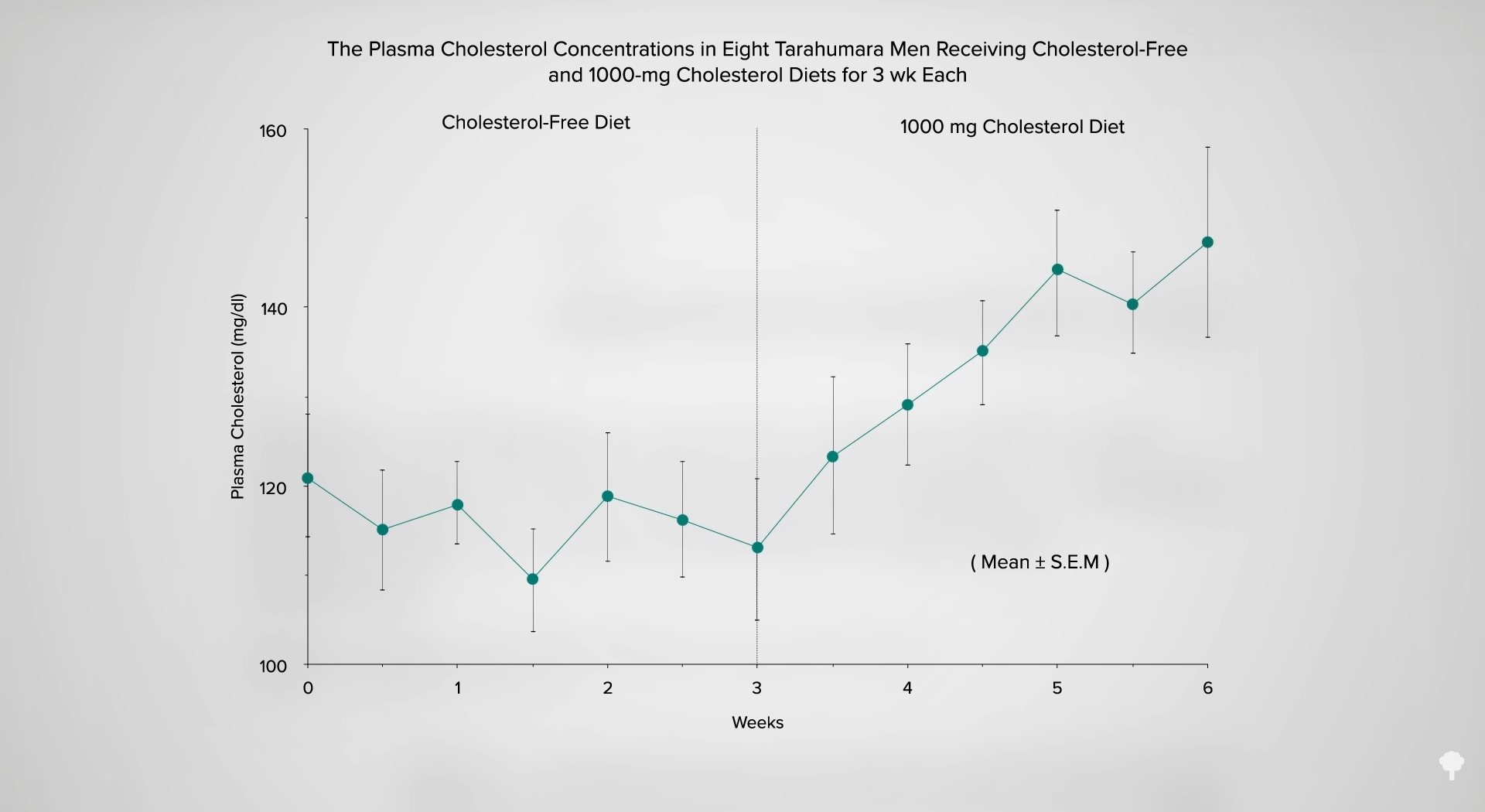
“Probably not since the days of the ancient Spartans has a people achieved such a high state of physical conditioning.” So, what do they eat? They eat the same kind of 75 to 80 percent starch diet, based on beans, corn, and squash, and have the cholesterol levels to prove it, with total cholesterol levels down at 136 mg/dL, which is essentially heart attack-proof. They don’t have special genetics, either, because data show that if you feed them enough egg yolks, their cholesterol levels creep right up, as you can see at 2:52 in my video.

Modern day Olympic runners eat similarly. What are they eating in Kenya? They’re following a 99 percent vegetarian diet centered mostly on various starches. But, as in all of these cases, is their remarkable physical prowess because of their diets or in spite of them? Or, does their athleticism have nothing to do with what they’re eating? You don’t know until you put it to the test.

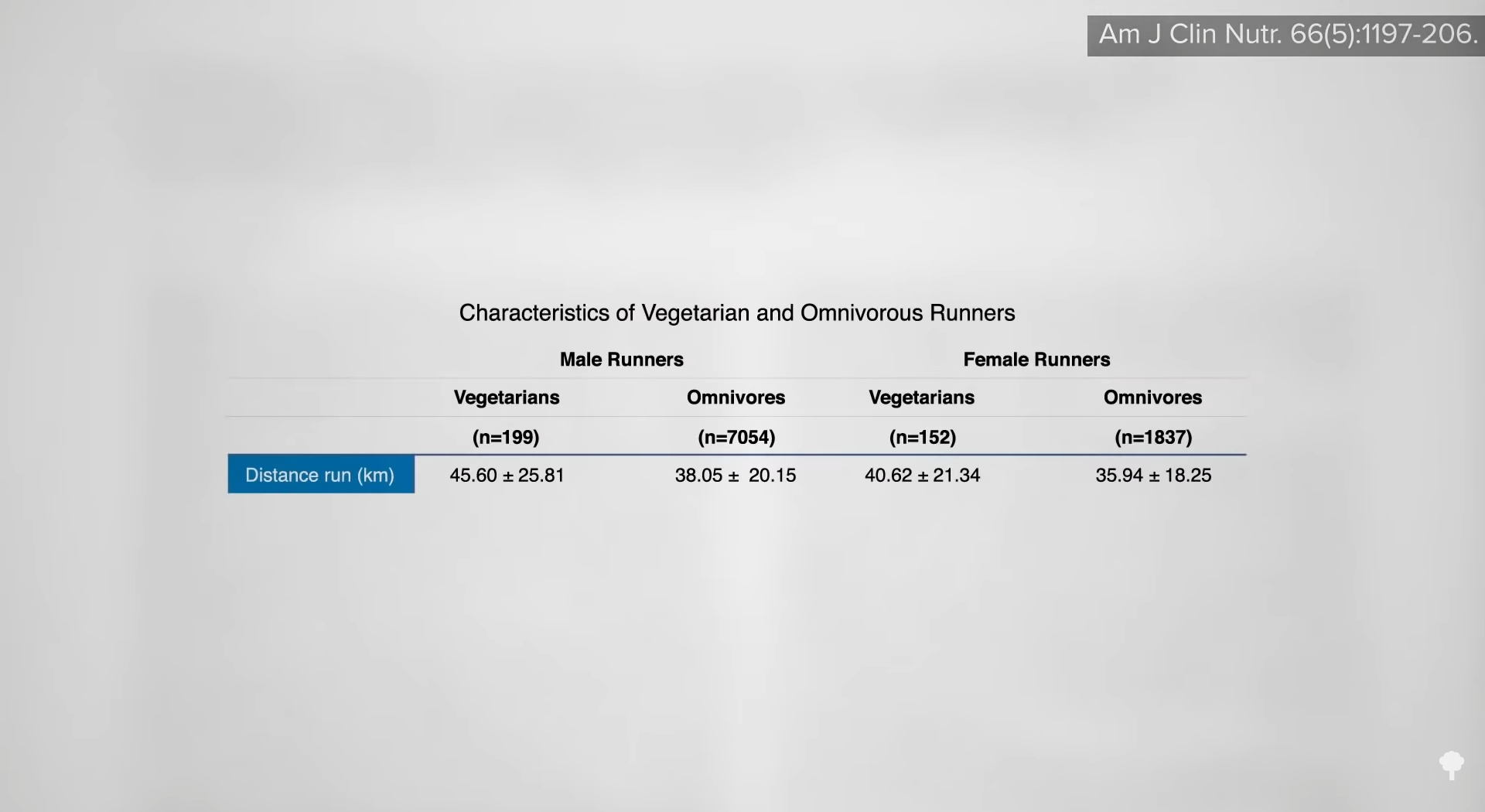
“In spite of the well-documented health benefits of vegetarian diets, less is known regarding the effects of these diets on athletic performance.” Researchers compared elite vegetarian and omnivore endurance athletes for aerobic fitness and strength by comparing oxygen utilization on the treadmill and quad strength with leg extensions. The vegetarians beat out their omnivore counterparts for cardiorespiratory fitness, but their strength didn’t differ. This suggests, at the very least, “that vegetarian diets do not compromise performance outcomes and may facilitate aerobic capacity in athletes.” But, this was a cross-sectional study. Is it possible the vegetarian athletes were just more fit because they trained harder? The National Runners’ Health Study looked at thousands of runners, and, as you can see at 4:06 in my video, vegetarian runners were recorded running significantly more on a weekly basis. Maybe that explains their superior fitness, though perhaps their superior fitness explains their greater distances.

Other cross-sectional studies have found no differences in physical fitness between vegetarian and non-vegetarian athletes, while another one found even worse performance among vegetarian athletes, but there could have been socioeconomic or other confounding factors. That’s why we need interventional studies to put different diets to the test and then compare physical performance.


from NutritionFacts.org https://ift.tt/zqfnMD3
via IFTTT

7 Day Healthy Meal Plan (Feb 13-19)

A free 7-day, flexible weight loss meal plan including breakfast, lunch and dinner ideas and a shopping list. All recipes include macros and WW points. 7 Day Healthy Meal Plan Valentine’s Day is here! I feel like this year is flying by already! You can start the day with these cute Heart Shaped Chocolate Chip Banana Pancakes! If you are looking for a romantic

from Skinnytaste https://ift.tt/DfimIYb
via IFTTT

Chocolate Brownie Date Balls

These Chocolate Brownie Date Balls are perfect when you need a sweet chocolate fix! A healthy, no-bake dessert or snack! Chocolate Brownie Date Balls These energy balls can be eaten as a snack or dessert when craving chocolate. They’re made with just a few ingredients – dates, walnuts, pumpkin puree, cocoa powder, and vanilla extract

from Skinnytaste https://ift.tt/Jwm5q8Y
via IFTTT

Chocolate Brownie Date Balls

These Chocolate Brownie Date Balls are perfect when you need a sweet chocolate fix! A healthy, no-bake dessert or snack! Chocolate Brownie Date Balls These energy balls can be eaten as a snack or dessert when craving chocolate. They’re made with just a few ingredients – dates, walnuts, pumpkin puree, cocoa powder, and vanilla extract

from Skinnytaste https://ift.tt/Jwm5q8Y
via IFTTT

Design a site like this with WordPress.com
Get started