Every month, we publish around eight new videos, four Friday Favorites, eight blogs, and four podcasts on NutritionFacts.org. We are bursting at the seams with all sorts of health and nutrition info that we don’t want you to miss, so we wrapped up the juiciest bits into a nice, bite-sized blog as an end-of-month recap in case you missed anything or just want a refresher. So, what were some highlights from April?

Dietary Guidelines: “Eat as Little Dietary Cholesterol as Possible”
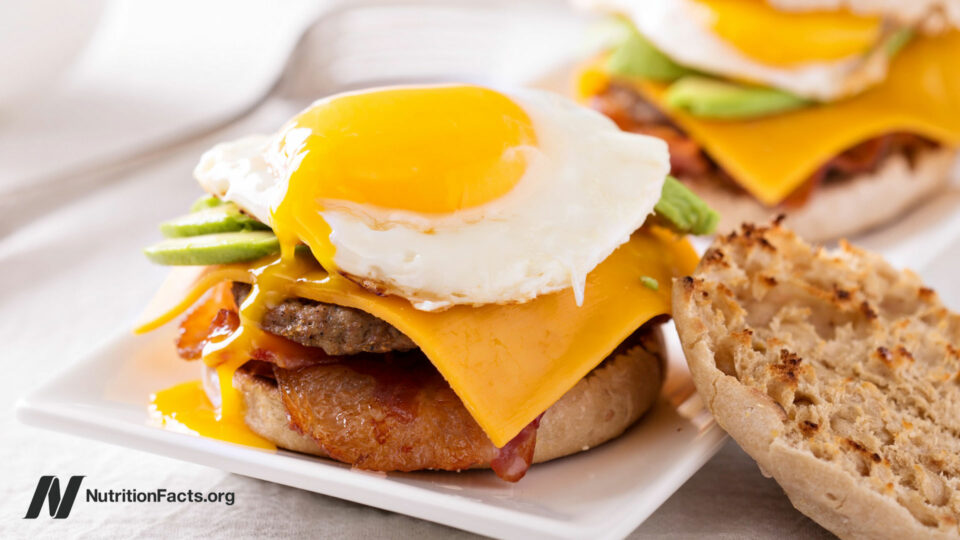 The reason we care about cholesterol is because we care about heart disease, the number one killer of men and women. Individuals who eat more eggs have been found to have significantly higher coronary artery calcium scores, which is a sign of atherosclerotic plaque buildup in the arteries. And, this seems to translate into a higher risk of heart attacks and death. Each additional half an egg consumed per day was significantly associated with higher risk of developing cardiovascular disease and dying from all causes put together. The Institution of Medicine recommends that individuals should eat as little dietary cholesterol as possible, and this was reiterated in the 2020 – 2025 Dietary Guidelines for Americans. Dr. Greger has testified before the committee a couple of times. Check out the highlights from 2020.
A Case of Stage 3 Cancer Reversal with Fasting and Spontaneous Regression of Cancer with Fasting
 Dr. Greger previously addressed what to eat after a cancer diagnosis, but what about eating nothing at all? In 2015, a remarkable case report was published in which a woman with stage 3 follicular lymphoma underwent a medically supervised, 21-day water-only fast, after which her enlarged lymph nodes were substantially reduced in size. The patient then remained on a whole food, plant-based diet, and, at six- and nine-month follow-up visits, she remained asymptomatic. After three years, her follow-up was published: Remarkably, she appeared to remain cancer-free, confirmed by CT and PET scans, with no additional intervention other than the dietary change. At present, long-term fasting in cancer treatment is supported only by some case reports, so more research is desperately needed. In the meantime, starting on a healthier diet seems like a win-win. In fact, following a whole food, plant-based diet free of sugar, oil, and salt—with or without fasting—is sometimes sufficient to induce an intense healing response.
Friday Favorites: Win-Win Dietary Solutions to the Climate Crisis
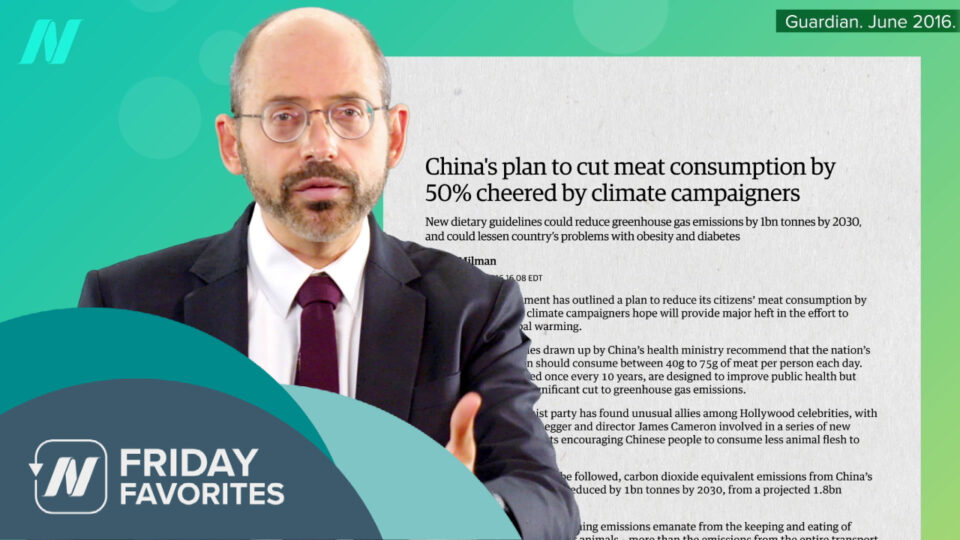 Happy Earth Month! Did you know we have the power to improve our own health and that of our planet every time we eat? We are facing a climate emergency. Fossil fuel use is going up, but so is per capita meat consumption. In fact, one of the solutions to help the climate crisis is to eat mostly plant-based foods and reduce consumption of animal products. What makes designing a sustainable diet so easy is that the same advice is good for us and our planet. The least healthy foods also sometimes cause the worst environmental impact. The foods with the most nutrition often just so happen to be the foods that cause the lowest greenhouse gas emissions, so we get a win-win effect.

Can Oxidized Cholesterol 27HC Explain Three Breast Cancer Mysteries?
 For more than a century, we’ve known that cholesterol may be associated with cancer proliferation. Consumption of dietary cholesterol increases breast cancer risk, and there appears to be a dose-response—the more cholesterol consumed, the higher the risk. Researchers found that about two years after breast cancer treatment (surgery, chemotherapy, and radiation), not one woman in the lowest third of LDL cholesterol blood levels had a recurrence of breast cancer, but that was not the case for women with higher cholesterol.
It was recently discovered that 27-hydroxycholesterol (27HC) is a cholesterol metabolite that can function as an estrogen and increase the proliferation of estrogen receptor-positive breast cancer cells, as well as stimulate prostate cancer cell proliferation. So, it isn’t necessarily the cholesterol, but what cholesterol turns into; oxidized cholesterol may play a role in the initiation, promotion, and progression of cancer. Some estrogen-driven breast cancer tumors may rely on 27HC to grow when estrogen isn’t available. 27HC may also explain why breast cancer patients with higher vitamin D levels appear to live longer, as vitamin D supplementation decreases 27HC levels in the blood. For Dr. Greger’s vitamin D recommendations, see our Optimum Nutrients page.
Is It Safe to Consume Cannabis Edibles?
 Smoking cannabis can create respiratory problems, so using a vaporizer is an alternative, but what about eating it? Edibles may carry increased risks to children and pets, as well as increased risk of overdosing, which can lead to severe respiratory depression. The American Academy of Pediatrics continues to oppose legalization. At the very least, cannabis edibles shouldn’t be packaged to look like popular candy, like Keef Kat, Buddahfinger, and Munchy Way. Some states have banned selling marijuana-infused candy with that kind of imagery, but to play it safe, perhaps we shouldn’t be making cannabis candy at all.
One issue with edibles is that it may take an hour or two after consumption before an effect is felt, so users may overconsume, thinking they didn’t ingest enough to feel an effect when they perhaps didn’t wait long enough. In fact, there have been case reports of individuals dying after overconsuming cannabis edibles. If you’re interested in learning more about cannabis, check out our extended series starting with The Institute of Medicine Report on the Health Effects of Marijuana.

The Right Idea, the Wrong Message
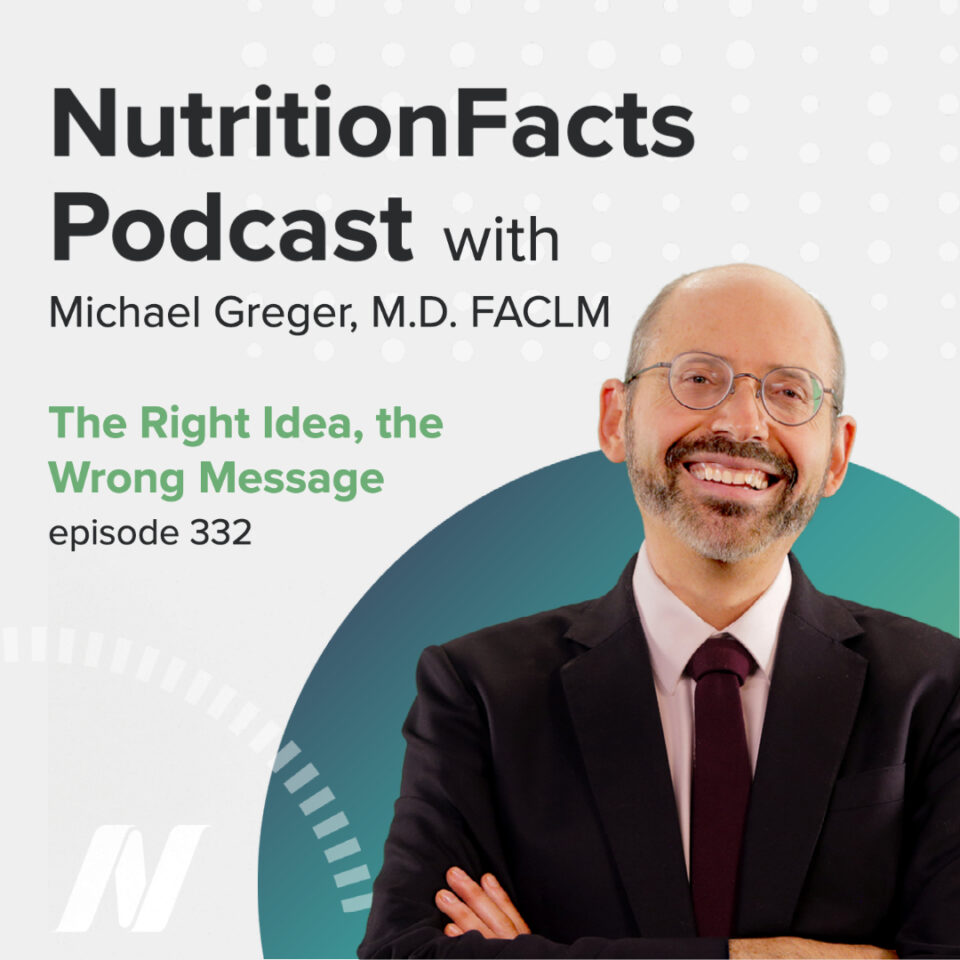 When individuals were offered a bacon cheeseburger, a chicken sandwich, or a fish sandwich, 17 percent chose the bacon cheeseburger. Swap out the fish sandwich choice for a veggie burger, and bacon cheeseburger preference doubled to 37 percent. How can offering a healthier food option actually drive people to make even worse choices? It’s thanks to a mind-blowing glitch of human psychology called self-licensing. The thought is that when we see a healthier option, many may make a mental note to choose that at some unknown next time, thereby giving them the excuse to indulge now. We may unwittingly justify doing something that draws us away from our goals after we’ve just done something that takes us towards them—like justifying eating a donut because you lost so much weight last week. Not only does making progress towards a goal rationalize decision making that undermines us, but even just considering making progress can have a similar licensing effect. Listen to the podcast to hear more about this fascinating glitch and the wild reality of “remedy marketing.”
This has been a wrap-up of just a small sampling of our recent content. To see everything from the past month, be sure to check out the video, blog, and podcast pages.
from NutritionFacts.org https://ift.tt/kPfNTMd
via IFTTT

 MyWellCare